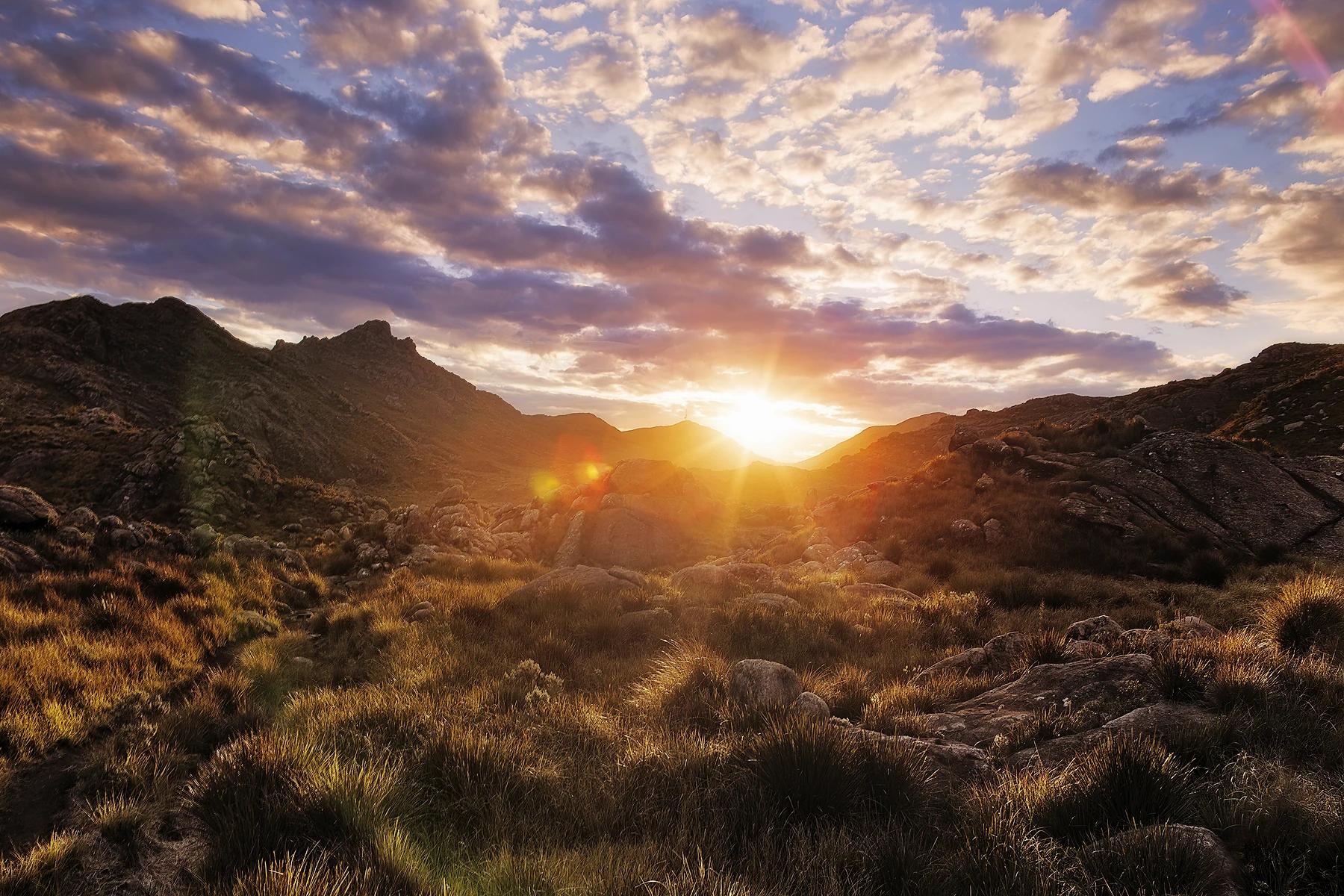
Climb high enough in the mountains of Rio de Janeiro State and the Atlantic Rainforest ends — not with a wall but with a surrender, the trees shrinking into elfin thickets and then into open campos de altitude: grass, rock, mist, and silence. Most travelers never learn that this high world has its own fauna, rarer and stranger than the forest’s.
The birds of the plateau are specialists of a harsh, beautiful niche: seedeaters and finches working the grass, swifts riding the wind off the cliffs, and endemics whose entire global range is a chain of mountaintops. The mornings arrive from below — cloud filling the valleys while you stand in sunlight — and the photographic light is Alpine in quality, tropical in content.
In the elfin forest just below the plateau, the cast changes again: a tapaculo whose explosive song erupts from a bird the size of a wren; hummingbirds like the topetinho-vermelho working the high flowers; and, in the tall montane forest, the great montane community — pihas, tanagers, and the muriqui’s quiet country.
Altitude compresses rarity. A morning up here can produce birds that many Brazilian birders have chased for decades. It can also produce, simply, the deepest quiet you will ever stand inside — which is its own kind of sighting.
✦ Sources & further reading
- ICMBio — Parque Nacional do Itatiaia — the high country of this article — campos de altitude above 2,000 m in Brazil's first national park · www.icmbio.gov.br/parnaitatiaia
- IUCN Red List of Threatened Species — status of the high-altitude species of the Serra da Mantiqueira · www.iucnredlist.org