No bird announces the tropics like a toucan. In the forests of Rio de Janeiro State you can meet five members of the family — and once you learn their habits, you will understand why our guides plan whole mornings around fruiting trees.
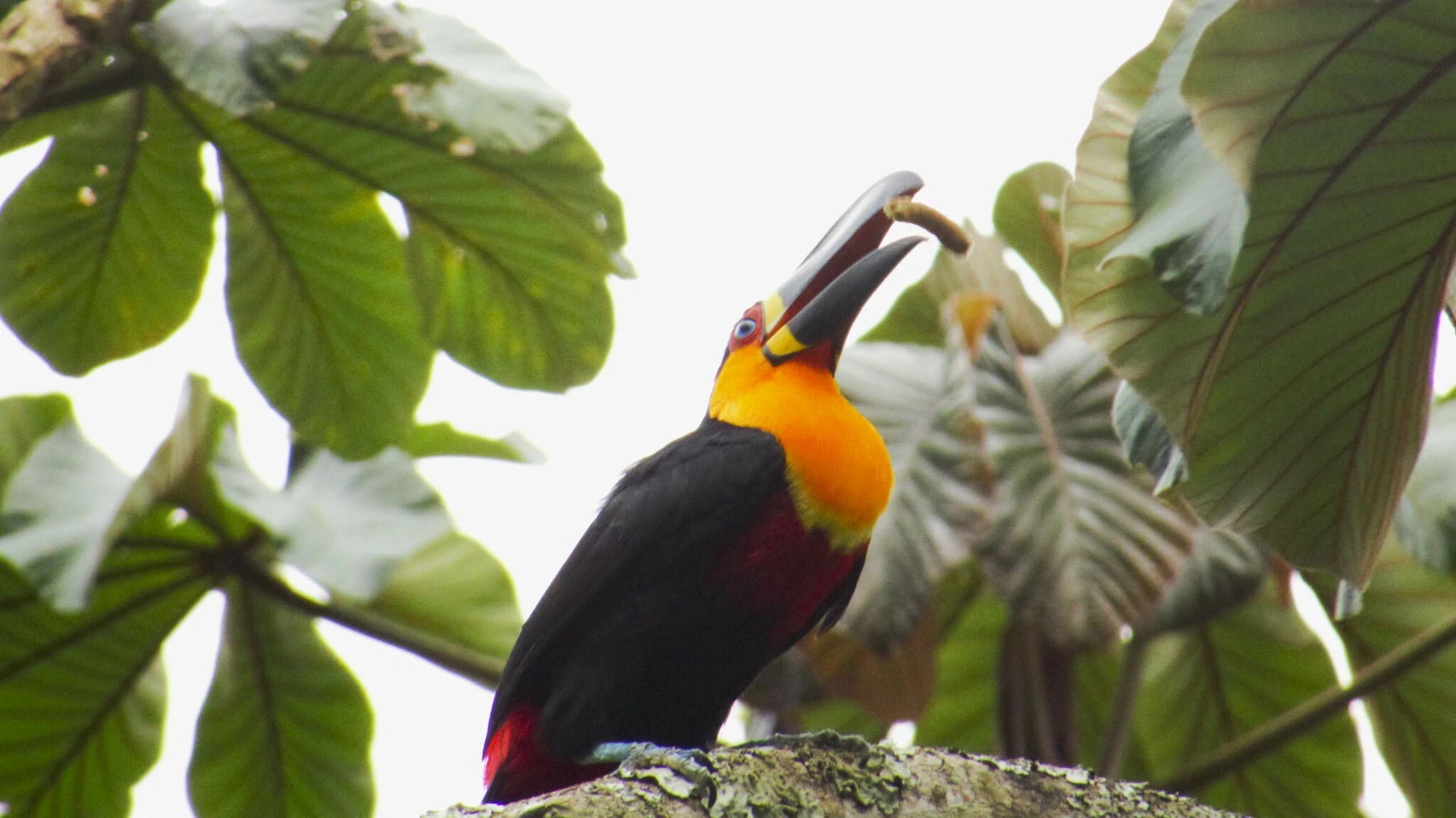
The channel-billed toucan is the celebrity of these forests: black with a golden bib and a great bill of painted blue and orange channels, it patrols the canopy in loud, yelping gangs from REGUA to Tijuca. The red-breasted toucan — the tucano-de-bico-verde — is the mountain specialist, its bill the colour of deep jade, common around Lumiar and Itatiaia.
Then come the araçaris, the toucan family’s elegant middle children. The saffron toucanet — araçari-banana — is a Lumiar speciality, gold and crimson and absurdly photogenic. The spot-billed toucanet, araçari-poca, is smaller, quieter, and on many birders’ most-wanted lists.
The fieldcraft is simple: toucans are frugivores with fixed routes. Find a fruiting tree — your guides will know which ones are loaded that week — set up downwind with the light behind you, and wait. The birds arrive in loose convoys, and a good tree can hold several species at once. It is the closest thing the forest offers to a scheduled performance.
✦ Sources & further reading
- Cornell Lab of Ornithology — Birds of the World — species accounts for the toucans and aracaris of the Atlantic Forest · birdsoftheworld.org
- eBird — Cornell Lab of Ornithology — sightings data for Rio de Janeiro State · ebird.org