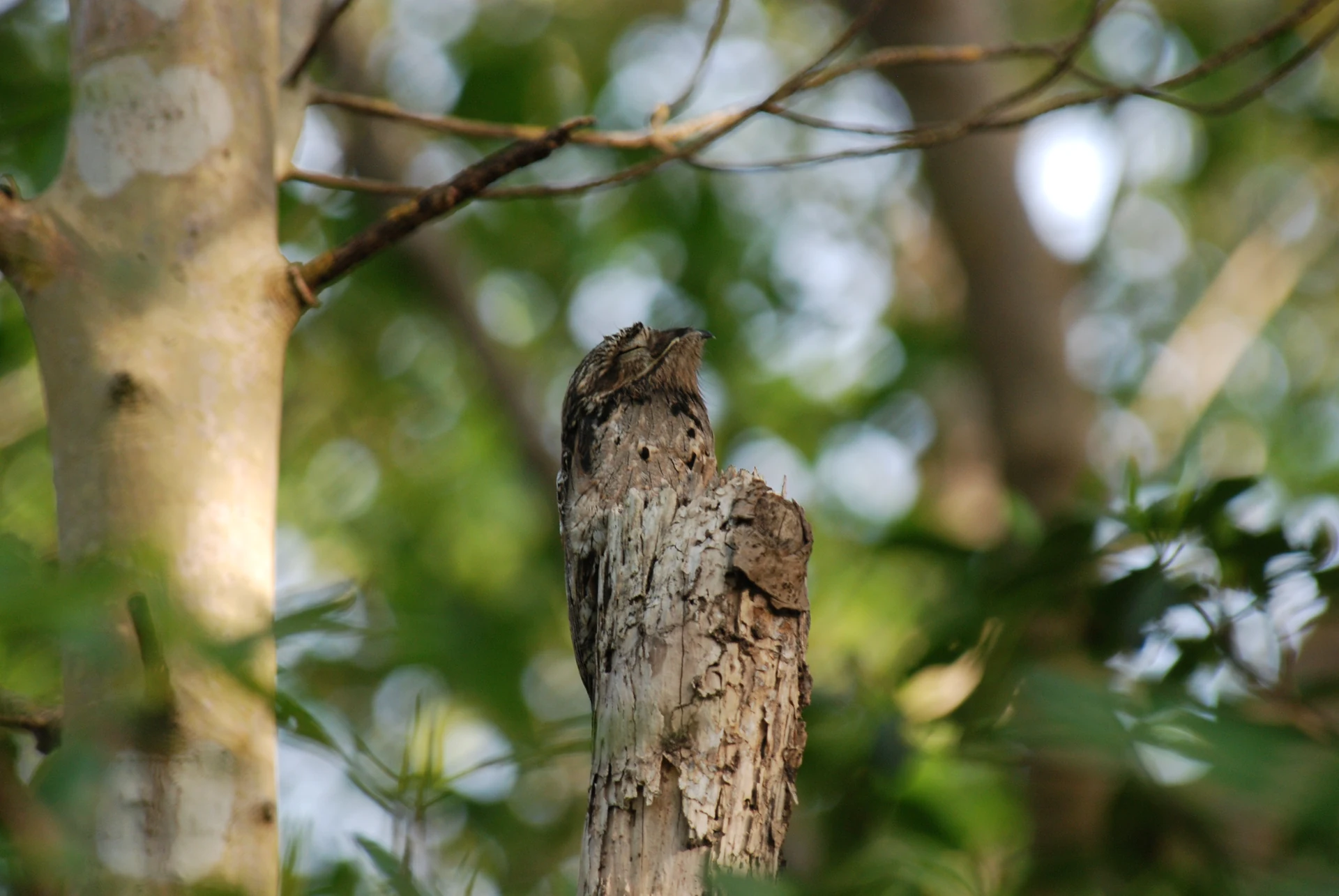
There is a bird in the Atlantic Rainforest that spends its entire working life pretending not to be a bird. The common potoo — urutau, in Portuguese, a name that imitates its call — perches upright on a dead stump, compresses its body into a gnarled spike, seals its enormous eyes to slits, and becomes, indistinguishably, a broken branch. People have photographed one for ten minutes before realising it was alive.
Then night falls, and the disguise artist becomes an opera singer. The potoo’s call is a slow, descending series of notes of such pure melancholy that Brazilian folklore filled it with ghosts: abandoned children, weeping lovers, the forest mourning itself. Even hardened field biologists go quiet when it starts.
Finding one is a guide’s art. Daytime potoos sit on favoured posts for weeks, motionless; our trackers keep a mental map of current birds. At night, the huge eyes betray them in the torch beam — two lanterns where a stump should be.
It is not the rarest bird on our routes, nor the most colourful. It is simply the one guests write home about. Some creatures you tick off a list. The potoo you remember at odd moments for years — usually when a forest goes quiet.
✦ Sources & further reading
- Cornell Lab of Ornithology — Birds of the World — species account of the common potoo (Nyctibius griseus) · birdsoftheworld.org
- WikiAves — the Brazilian birding community's reference, with recordings of the potoo's call · www.wikiaves.com.br