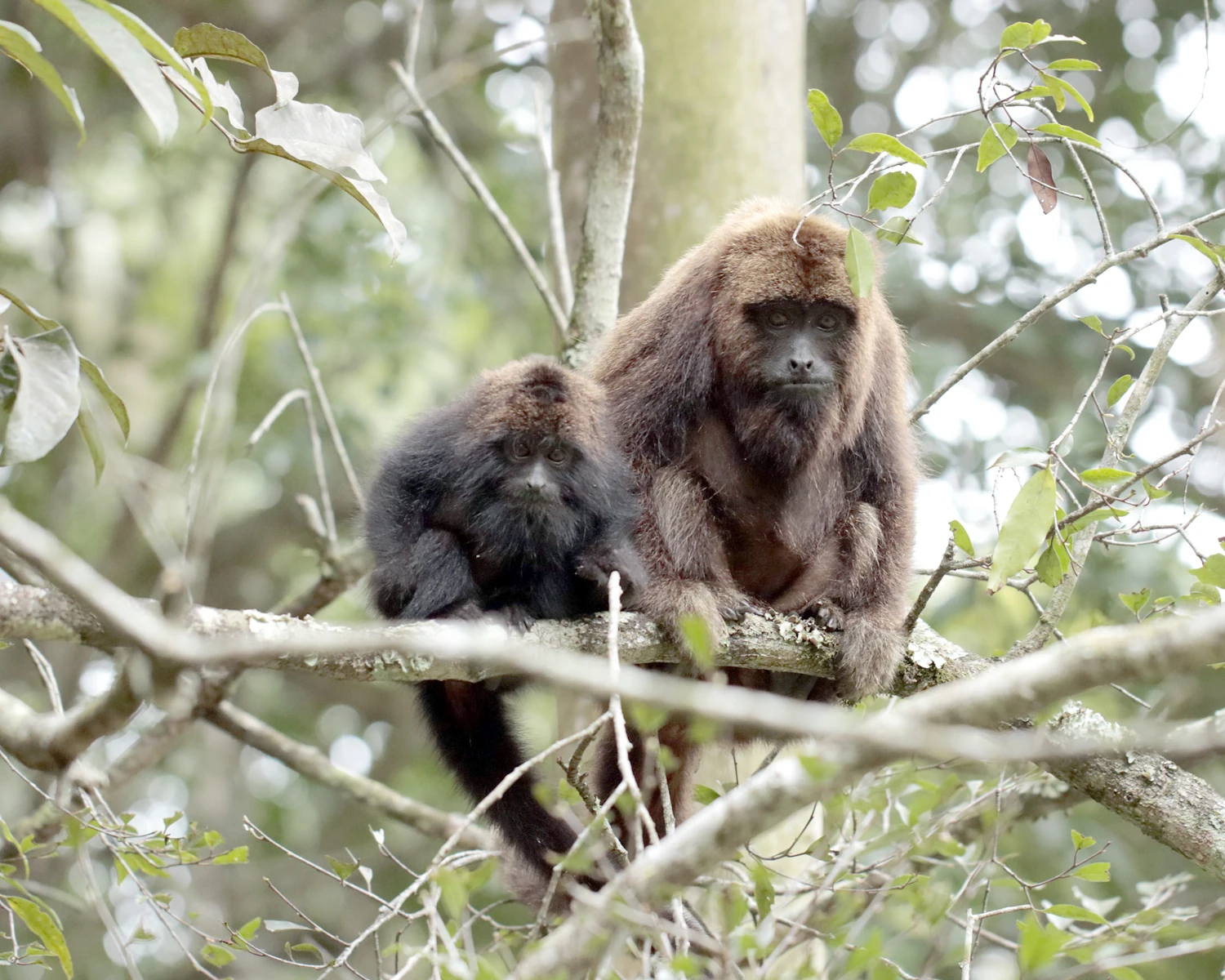
Long before you see a howler monkey, the howler monkey has introduced itself. The brown howler — bugio — produces the loudest call of any land animal on Earth: a rolling, atmospheric roar that carries three kilometres through the forest and sounds, to first-time listeners, like wind in a tunnel, like distant surf, like something geological.
The instrument is an enlarged hyoid bone, a hollow resonating chamber in the throat that turns a monkey the size of a small dog into a foghorn. Males call at dawn to map the neighbourhood — which troops are where, who should keep their distance — and on humid mornings the whole canopy seems to answer itself.
Finding them afterwards is a matter of following the sound uphill. Howlers are deliberate animals: they move slowly, feed mostly on leaves, and spend admirable percentages of the day doing nothing visible at all. Through binoculars, a group at rest — russet bodies draped over branches, tails wrapped like fifth hands — has a philosophical quality.
In the Living Corridor, the bugio’s roar is the forest’s all-clear. Where howlers have been lost to hunting or fragmentation, the silence is one of the saddest sounds a naturalist knows. Here, they still announce the dawn. We schedule mornings around them.
✦ Sources & further reading
- IUCN Red List of Threatened Species — status of the brown howler (Alouatta guariba) of the Atlantic Forest · www.iucnredlist.org
- Macaulay Library — Cornell Lab of Ornithology — recordings of howler calls — the loudest primate voice in the forest · www.macaulaylibrary.org