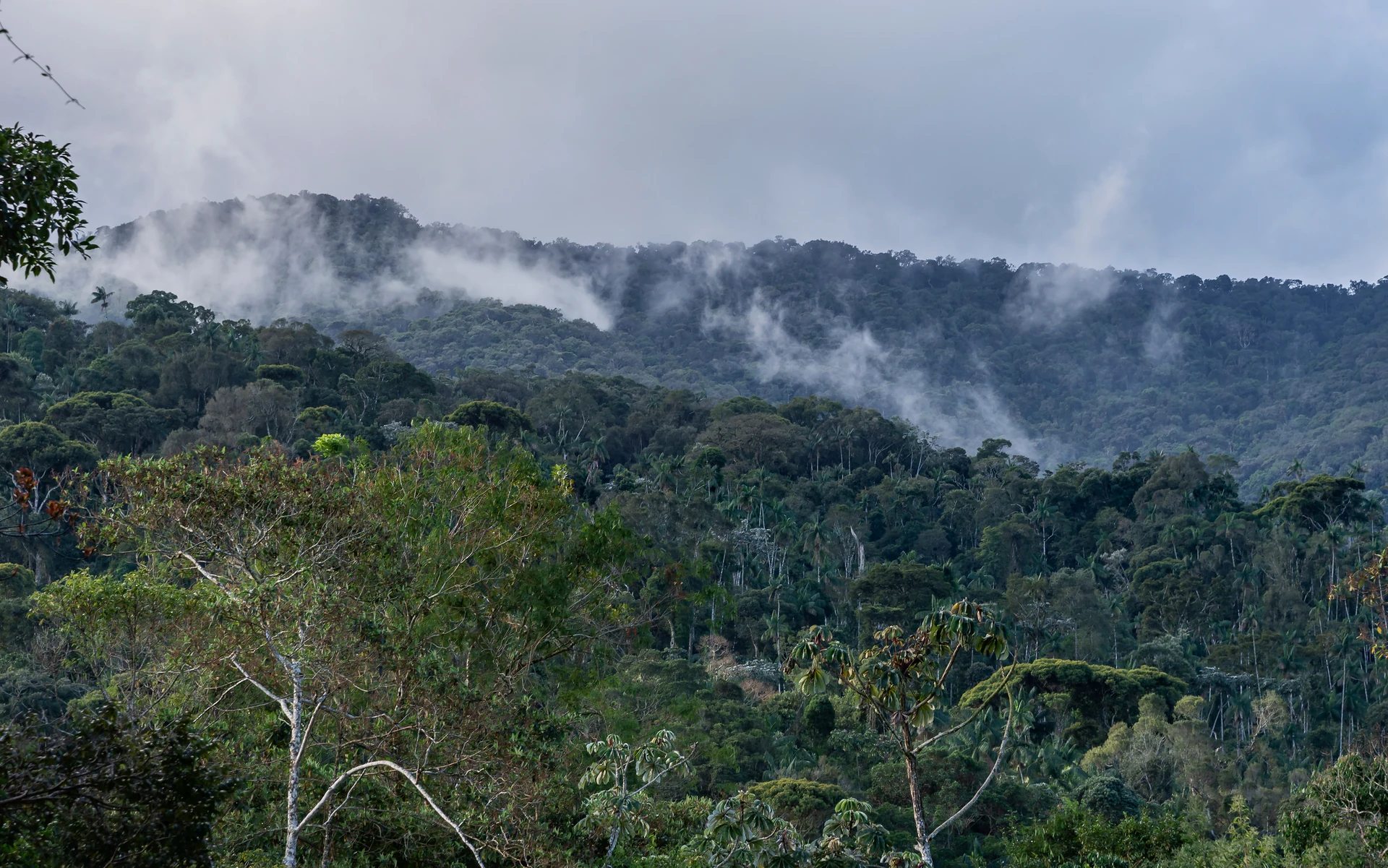
Ask a scientist and she will say Atlantic Forest. Ask a lodge owner in the mountains or a travel designer in London and they will say Atlantic Rainforest. Ask a Brazilian and you will hear Mata Atlântica. Three names, one forest — the great green mantle that once ran almost unbroken along Brazil’s eastern seaboard, from Rio Grande do Norte to Rio Grande do Sul, and inland up the coastal escarpments.
The naming split tells a story. "Atlantic Forest" is the cartographer’s term, born of science and policy. "Atlantic Rainforest" is the traveler’s word — the one you will find in international brochures, birding itineraries and the dreams of photographers — because it describes what the place actually feels like: rain, mist, epiphytes dripping from every branch. Both are correct. When you search for your journey, use whichever you like; the forest does not mind.
What the forest does mind — if a forest can — is being confused with its famous sibling. The Amazon is bigger, louder in the media, and a continent away. The Atlantic Rainforest is older in its isolation, and per hectare it is richer: compressed between ocean and escarpment, it became a laboratory of endemism. There are creatures here that exist in a single valley and nowhere else on the planet — birds, frogs, orchids, primates. The golden lion tamarin is merely the most photogenic of thousands.
It is also the most endangered major forest on Earth. Around a tenth survives, mostly in the coastal mountains — which is why the surviving fragments of Rio de Janeiro State have become some of the most studied, protected and quietly celebrated conservation landscapes in the world.
For the traveler, the practical consequence is strange and wonderful: this is the rarest great forest on the planet, and you can have breakfast in Rio de Janeiro and be standing inside it before lunch. Two names, one forest, no queue.
✦ Sources & further reading
- World Land Trust — Atlantic Forest, Brazil — overview of the biome: one of the world's top biodiversity hotspots, with around 7% of its original cover remaining · www.worldlandtrust.org/project/atlantic-forest
- IUCN Red List of Threatened Species — the global reference for the conservation status of the forest's species · www.iucnredlist.org